Button sewing machine: Types and Operation
Sep 12, 2023
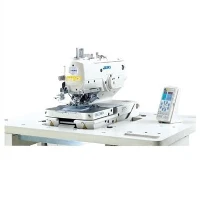
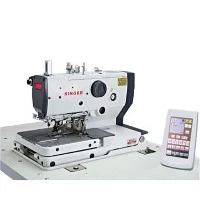
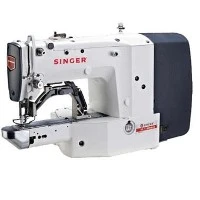
A button sewing machine is an industrial sewing machine designed to automatically sew buttons, snap fasteners, hooks, labels, and pairs of items such as socks and gloves of various shapes and sizes. It is suitable for large-scale production in sewing factories and other industrial sectors.
Types of Button Sewing Machines
Button machines can be categorized into two types: single-thread chain stitch and double-thread lock stitch machines. Double-thread lock stitch machines require frequent bobbin thread changes during button sewing, limiting their versatility. Single-thread chain stitch machines, on the other hand, do not require thread changes during button sewing, resulting in higher production efficiency. There are two subtypes of single-thread chain stitch machines: one with needle swinging and the other with button clamp swinging. The former swings the needle left and right during button sewing, while the latter only moves the needle up and down while the button clamp swings left and right. The needle swinging type is preferred in sewing factories due to its durability, low noise, reduced operator fatigue from the button and fabric swinging together, and higher production efficiency.


Button Forms for Sewing
Buttons come in various forms, including double-hole or four-hole flat buttons suitable for sewing on men's shirts, knitted fabrics, underwear, etc., with small diameters. Rolled edge buttons are suitable for sewing on medium-thick materials such as wool coats, suits, raincoats, etc., and have larger diameters. Handle or metal ring buttons are used for military uniforms, uniforms, and identification buttons. Additionally, the machines can also be used for sewing snap fasteners and labels.
Button Sizes
Button sizes in China are typically expressed in terms of the outer diameter of the button, while internationally, button sizes are commonly measured in lignes (Ligne is equivalent to 0.635 mm). For example, an 18 lignes button commonly used on men's shirts has an outer diameter of 11.4 mm. Generally, machines like the J series are suitable for buttons with diameters ranging from 9 to 26 mm.

Stitch Patterns and Stitch Counts for Button Sewing
Stitch patterns include "X," "T," "Z," and designated non-bar tack types. Stitch counts range from 6 stitches, 12 stitches, and 24 stitches to 8 stitches, 16 stitches, 24 stitches, and designated stitch counts.
Button Sewing Machine Operation
Button sewing machines are highly automated. The operator simply needs to attach the button, set its position, and press the control pedal. The sewing machine will automatically sew the button, and once the specified stitch count is reached, the machine stops and cuts the thread automatically. Fully automatic button machines come with automatic button-attaching devices. For example, the GJ4-2 button machine sews "X"-shaped stitches with 20 stitches (16 thread paths) on 4-hole flat buttons. During the button sewing process, the machine needle first swings left and right in the front buttonholes from the 1st to the 9th stitch while the button and fabric remain stationary. After the 9th stitch, the button clamp moves the button and fabric longitudinally to form a bar tack between stitches 9 and 10. Then, the machine needle swings left and right in the rear buttonholes from the 10th to the 18th stitch. Finally, the machine needle continuously pierces and secures the thread in the right-side buttonhole for stitches 19 and 20. After the 20th stitch, the machine stops automatically, and the button clamp returns the button and fabric to their original positions. When the button clamp is lifted to remove the fabric, the thread is cut by a thread cutter or automatic thread trimmer, completing the button sewing process.
If you need to purchase a Singer Buttonhole Machine, you can choose DAPSEW. The brand we cooperate with is the Singer brand.
you can contact:
Email: evan@dapsew.com
WhatsApp: +8613186027908