How to coordinate the feeding action of the Coverstitch machine?
Mar 25, 2024
The coordinated fabric feeding action of the Coverstitch machine is closely related to the feed dog height, presser foot pressure, and differential feed ratio. When adjusting the feed dog height, the principle to follow is that the feed dogs should completely retract beneath the needle plate after the feeding action is completed. If the speed is too fast, it may cause the material to float or momentarily lose contact with the presser foot, affecting the stability of the stitch formation.
Accurate fabric-feeding action in Coverstitch machines can reduce the probability of skipped stitches. The main factors that routinely affect the feeding action are the feed dog height, presser foot pressure, differential feed ratio, stitch density, and operating speed. The main theory behind this is that the stability of the triangular loop formed on the back of the curved needle depends on the stability of the fabric feeding action and its correct coordination with the thread take-up cam. If the feeding action is unstable, the triangular loop will deform or fluctuate in size, preventing the needle from entering it.
When adjusting the feed dog height, the principle is that the feed dogs should fully retract beneath the needle plate after the feeding action is completed, without any backward movement of the material. The presser foot pressure should be adjusted to prevent the material from sliding towards the operator. For stretchy materials or when the operator pulls the material towards themselves with excessive force, the differential feed ratio should be increased.
It may be observed that when the curved needle begins to enter the looper thread loop, the loop is already distorted. If the curved needle is advanced slightly, after it enters the loop and contacts the thread below, causing friction and loop deformation, the curved needle may be unable to pass through the loop smoothly, resulting in a missed stitch.
To address this issue, the needle can be slightly tilted based on the degree of thread twist, as an unstable loop is formed when the looper thread is the farthest from the curved needle hook. When the thread quality is poor, the loop may become distorted beyond a certain range during formation, making it difficult for the curved needle to enter. Therefore, this loop tends to be the largest. The needle thread loop should accommodate the entry of the curved needle (the needle can only be slightly redirected; excessive redirection may cause skipped stitches). With smaller stitch densities, the triangular loop is also smaller, so the density should be appropriate, and larger is preferable within the acceptable range. When the curved needle enters the looper thread loop, its underside makes contact with the needle thread at the needle hole. As the curved needle moves to the left, the friction between the curved needle underside and the needle thread causes the loop to deform and distort more rapidly to the left. Excessive speed may cause the material to float or momentarily lose contact with the presser foot, affecting the stability of the stitch formation.
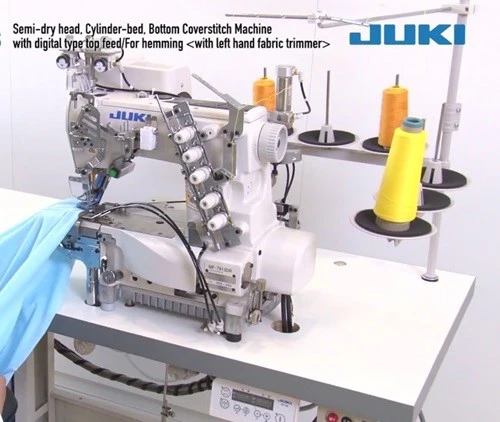
If you need to purchase Coverstitch machines, you can choose DAPSEW. The brand we cooperate with is the Juki brand.
you can contact:
Email: sales@dapsew.com
WhatsApp: +8613186027908